Designing for attention
Models keep getting smarter and faster. The limit is now us: how many decisions we can make in a day. Everything in Hey Atu starts from that.
The bottleneck has moved
For the last few years, the question was “can the model do it?” We built better prompts, longer workflows and more tools, because the model was the weak part.
That is no longer true for most everyday work. A good model with a small harness can research, write, fix code, watch a price or file an invoice. It does this faster than I can read about it.
So the limit has moved to the person. I still have one head and one day. Each task the agent finishes ends with something that needs me: a choice, an approval, a “yes, send it”, or just a moment to notice that it happened. Every one of those decisions is paid for with attention.
The model is the limit.
Build a stronger harness, add more skills.The person is the limit.
Spend less attention on each decision.That is the one idea behind the whole product. Hey Atu is not mainly a coding tool, and not only a chat app on a phone. It is a way to spend less of your attention on more of your work and your life.
Four levels of attention
The design comes from my own habits, built over more than ten years of work. I think it fits students as well: anyone who juggles many threads, some urgent and most not.
Not everything needs you at the same time. Some things need you now. Some things need you today, but not this minute. Some things only need a glance when they finish. And some things are only for when you have time to think.
Hey Atu has four tabs, and each tab is one of these levels:
- 1ChatsNow. Talk, decide, give feedback.
- 2TodoSoon, not now. Things to handle later.
- 3UpdatesAfter the agent works. Read the result.
- 4WikiWhen you are free. Sort your own thinking.
LEVEL 1Chats: attention now
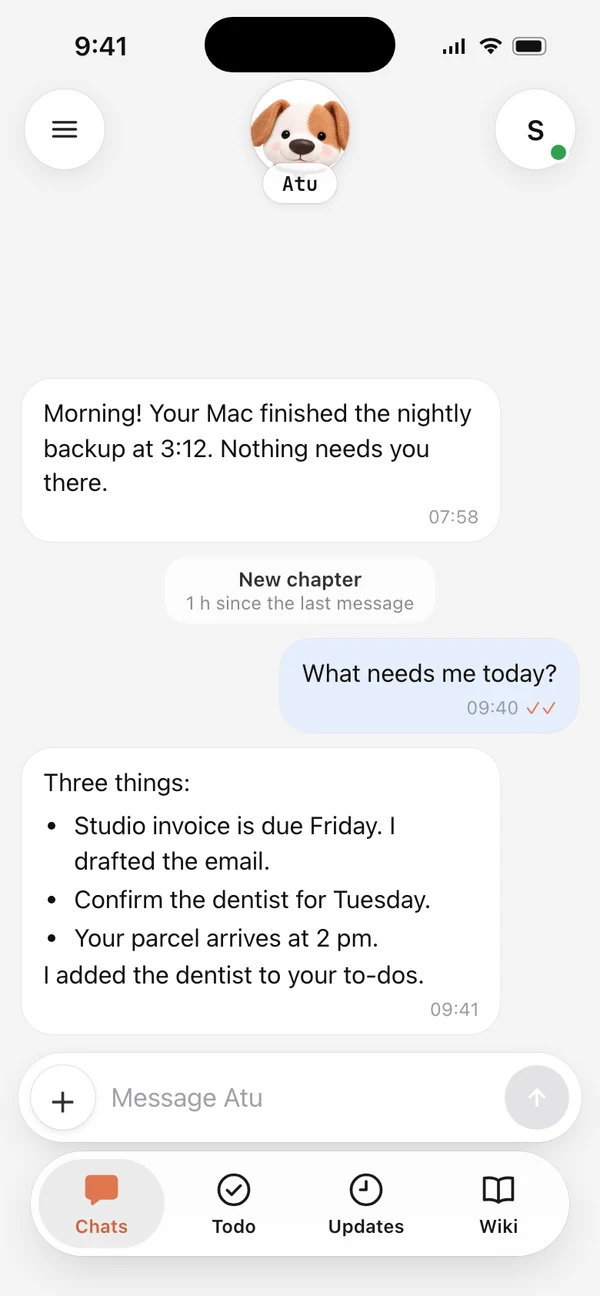
The conversation is the first need. It is where you and the agent think together: you ask, it works, you decide, you correct it. This is the most expensive kind of attention, because it is live.
So Chats must stay small. A message belongs here only when it needs a reply now. Everything else should go down a level. When the agent comes back to you, it gives the conclusion first and the options next to it, so you can decide in one line, from your phone, between two other things.
LEVEL 2Todo: shared by you and the agent
This one is a little unusual, and it is my favourite.
In 2025, Claude Code made the agent’s own to-do list popular. The agent wrote a plan, ticked items off, and stayed on track over a long task. It was built for the agent. In 2026, with stronger models, it started to matter less. Claude Code turned those to-do tools off by default for its newest models. The model simply does not lose track anymore.
But people still do. My head is full of random ideas, follow-ups and “I should check that”. Each one holds a small piece of my attention until I write it down.
Years ago I read David Allen’s Getting Things Done. Its main lesson stayed with me: get everything out of your head and into a place you can see and trust. Your mind is for having ideas, not for holding them.
> Fix the wrong dates on the invoices

● Update Todos
  ⎿  ☒ Read the failing test
     ☒ Find where dates are parsed
     ☐ Use the customer’s time zone
     ☐ Run the tests again
The agent plans one task and ticks it off. The list ends when the task ends.
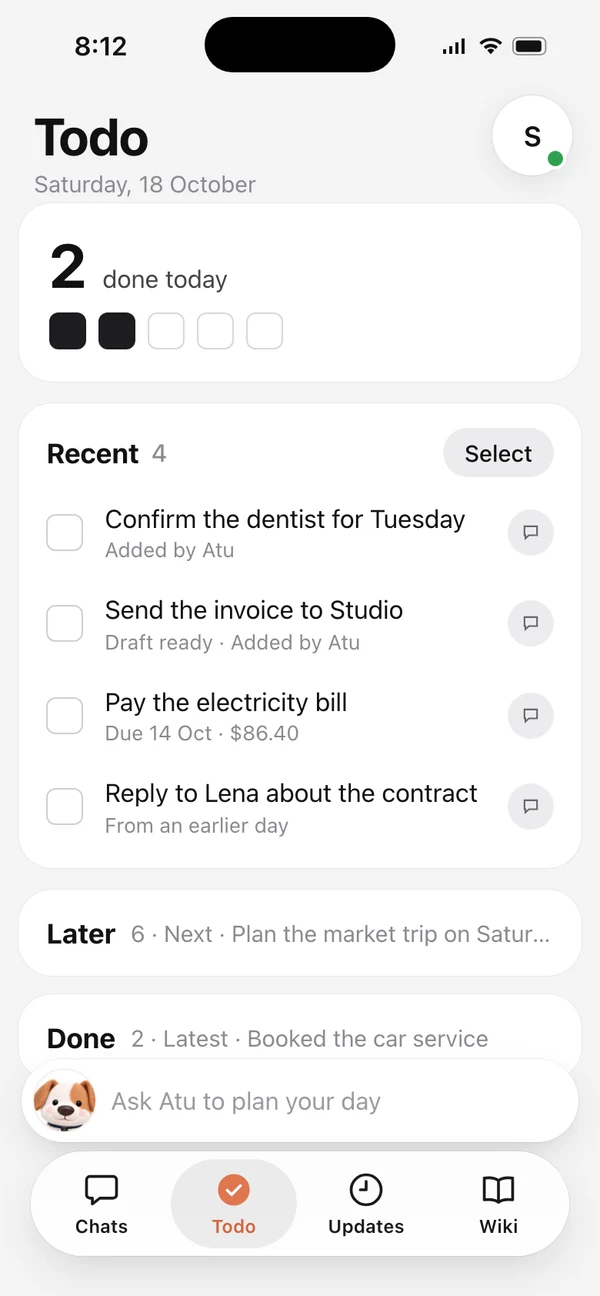
So Todo in Hey Atu is one list that you and the agent share:
- The same list, the same actions. You add, move and finish items on the phone. The agent does the same through a command line. Each change records who made it, and each change can be undone.
- Built from your chats. Say “remind me to follow up with Sam on Friday” in any chat, and it is on the list. A to-do also opens a chat, so you start the work from where you wrote it down.
- Kept true by the agent. We are now building the next step: Atu reads your finished chats. Work that got done goes into Done. A chat that stopped because it waits for you becomes a to-do with one line: what it needs from you.
The result is that you do not need to remember the open loops. You look at one list and see what is left.
LEVEL 3Updates: results that do not interrupt
Updates is close to what other tools call scheduled tasks: “check this price every morning”, “tell me when the build finishes”, “summarise my inbox at six”. The agent does the work while you are away.
The point is how the result reaches you. Most of these results are routine: a monitor that found nothing new, a sync that worked, a report you will read later. They do not deserve a chat, and they do not deserve to pull you out of what you are doing.
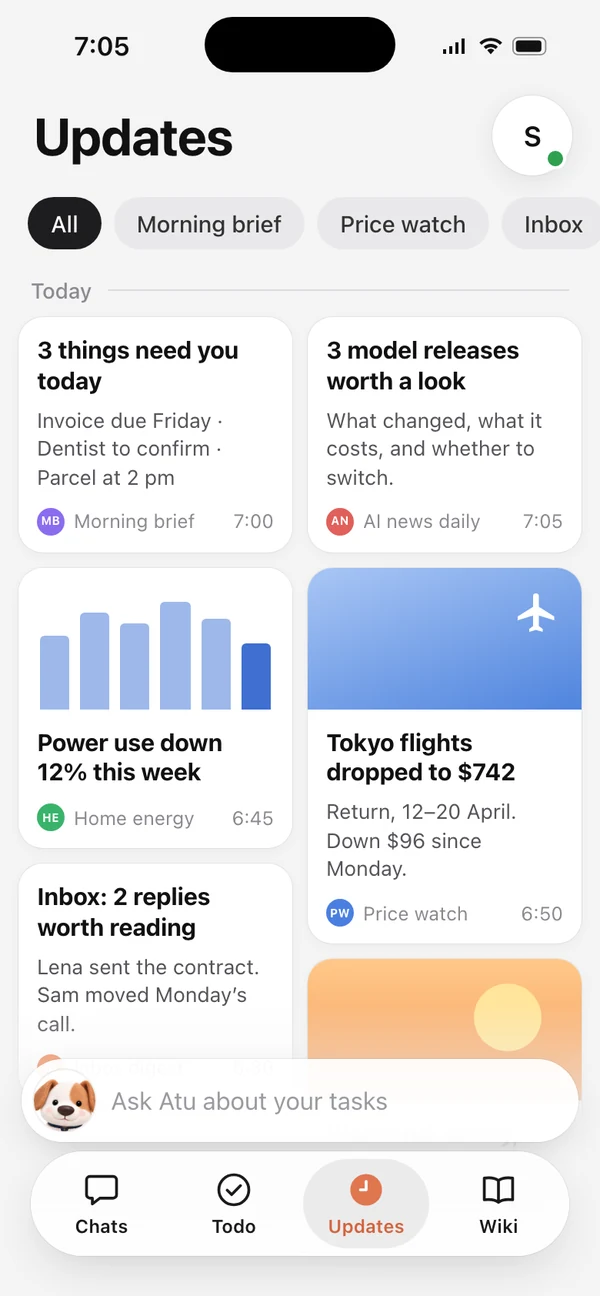
So they land in Updates, as a simple feed. You read it when it suits you. If one result does need a decision, it moves up: one tap starts a chat about it, or it becomes a to-do. And you can set the bar yourself, for example “only tell me when it drops below 1,300”.
LEVEL 4Wiki: a memory palace for what you learn
The last level is knowledge. It is the least urgent, and in the long run perhaps the most important.
We learn all the time: from articles and books, and more and more from our conversations with agents. A good answer in a chat is real knowledge. Then the chat scrolls away and the knowledge goes with it.
Knowledge only becomes yours when you come back to it. Anyone who learned words with flash cards knows the forgetting curve: you remember what you review, a little later each time. Without review, most of it fades within days.
The Wiki follows Andrej Karpathy’s idea of an LLM Wiki: an agent keeps a set of plain Markdown pages, so knowledge builds up instead of being searched for again each time. In Hey Atu it works like this:
- You only add. Chats, links, files, notes and folders on your Mac. You never sort or tag.
- Atu writes the pages. Each page is one lasting subject, and later sources keep adding to it. Pages link to each other.
- It grows while you sleep. Each night Atu adds the day’s new knowledge. Each week it tidies the structure: it merges, splits and links pages.
- It brings things back. The Wiki shows what was added last night and this week, so you review a little, often, instead of never.
# Japan trip

## Overview
Two weeks in April. Kyoto first, then Osaka.

## My view
“Fewer cities, longer stays.”

See [[Kyoto in April]] · [[Rail pass or not]]
Plain Markdown pages that link to each other. Atu writes them; you read them.
AGENTS.md
- One page is one lasting subject.
- “My view” keeps only my own words.
How Atu writes. When you correct a page, Atu adds the rule here.
I think of it as a memory palace. Tags are books, groups are chapters, pages are the text. Your knowledge gets a shape you can walk through, so you can see what you know and find it again. And it is all plain files on your own computer.
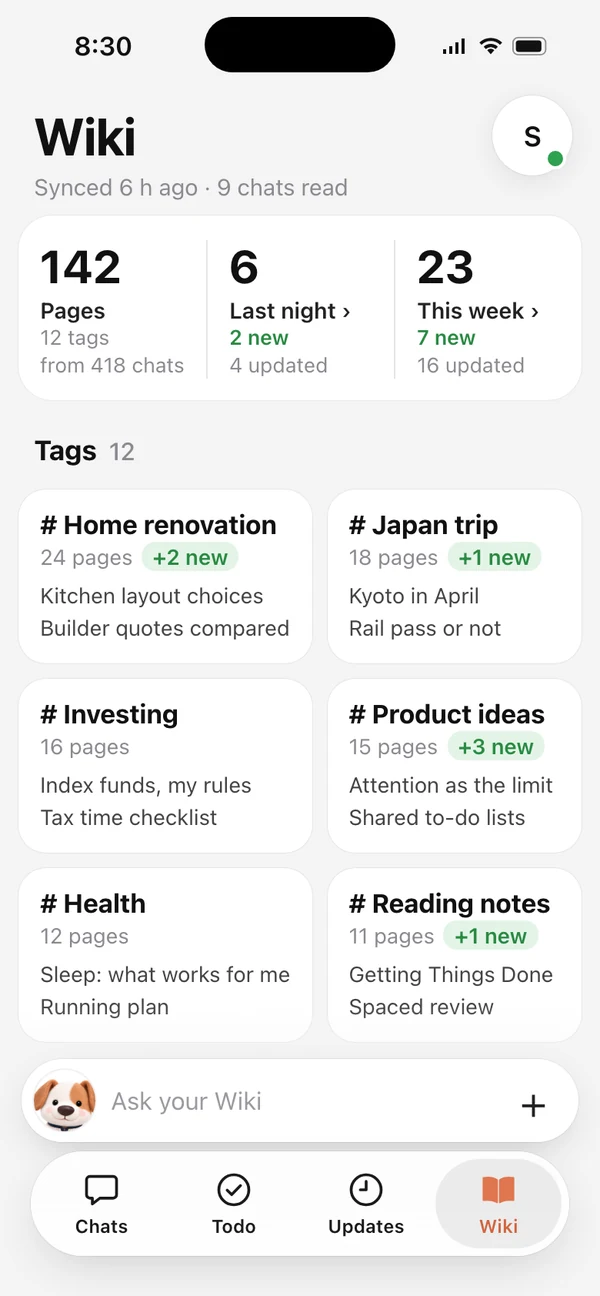
The Wiki never asks you for a decision. It has no pressure to read. It waits for the moments when you have time.
Things move between levels
The four levels are not four silos. Content moves, and the agent can move it for you:
One test helps me with every new feature: will this still be useful when the model is twice as strong? Clever agent workflows often fail that test, because the next model makes them unnecessary. Saving human attention passes it. The stronger the agent gets, the more work it finishes, and the more it matters how that work comes back to you.
That is what Hey Atu is for.
Hey Atu runs your AI on your own computer, and lets you use it from your phone. It is ready to try, with 100 free actions.
Get started